Should Gupta Conviction Affect Your MBA Decisions?

Insider Trading

“Ethics classes will be pretty ironic won’t it?”

I recently received the following comment from ANP on an April 2011 MBA Admissions News Round Up:

“I had posted that you are not giving a fair view to potential ISB applicants by ignoring the fact that Rajat Gupta was accused in the Galleon insider trading scandal. But well he has been convicted now. How does that change your view of ISB now that it’s founder is a convicted white-collar criminal? Ethics classes will be pretty ironic won’t it? I hope to see a post informing readers about this.”

Just in case there is an MBA applicant out there who doesn’t know, Rajat Gupta is an IIT grad and Harvard MBA who went on to become the Managing Director of McKinsey & Company. He co-founded the Indian School of Business and was chairman of its board until 2011. He also served on several corporate boards, including those of Goldman Sachs, AMR, and P&G; educational boards, including that of University of Chicago, Harvard Business School, Lauder Institute, Kellogg, MIT Sloan, and Weill Cornell; and charitable boards, including the Gates Foundation, India AIDS Initiative, World Economic Forum, and more.

Rajat Gupta was convicted last Friday of insider trading.

An arms-long list of felons either graduated from or actively supported business schools of varying pedigree, including Harvard (Gupta, Jeffrey Skilling), Wharton (Milken, Rajaratnam), and Kellogg (Fastow). Ivan Boesky, who was convicted of insider trading in the late 1980’s, actually taught at Columbia and NYU Stern prior to his conviction. These are just a few names that came to my mind; there are more.

Certainly the Hall of Shame from the last twenty-five years does not seem to have damaged the reputations of these programs or their ability to educate students and send grads on a trajectory of professional success. And the convictions of McKinsey alumni Skilling and Gupta haven’t diminished McK’s allure.

While certainly not badges of pride or associations to tout, the failings, mistakes, and even crimes of individual members of a community or institution don’t determine the value of that education or institution — provided the institution disavows and discourages the criminal behavior and that behavior is the exception rather than the rule. Those misdeeds belong to the individuals who went down the slippery slope and made the big mistakes that they are now paying or have paid for so dearly.

Unless moral purity is your sole criterion for choosing a school, I recommend that you choose schools based on the following:

  1. Ability to help you achieve your professional goals.
  2. Curriculum you want to study in the way you want to study it.
  3. Attractiveness of the school’s student life and extra-curricular activities.
  4. Personal preferences regarding location, family needs, etc.
  5. The likelihood of your acceptance.

ANP asks about ethics classes taught at ISB in light of Gupta’s conviction. In fact, last year an HBS prof corresponded with Bernie Madoff about his ponzi scheme; the purpose of the correspondence is research for a series of case studies. Business schools frequently bring in convicted felons to speak about their crimes and punishment. My understanding is that students have found these presentations more impactful than theoretical books and seminars with Thou Shalt’s and Thou Shalt Not’s.

How does Gupta’s conviction affect my opinion of ISB? It doesn’t. It affects my opinion of Gupta.

How about you?

Linda Abraham By , president and founder of Accepted.com and co-author of the new, definitive book on MBA admissions, MBA Admission for Smarties: The No-Nonsense Guide to Acceptance at Top Business Schools.


smartie-book


Indian School of Business MBA Adcom Member Interview Available Online

Indian School of BusinessThank you to Hima Bindu, the Associate Director of Admissions and Financial Aid at the Indian School of Business, for an excellent Q&A. Hima covered a wide range of topics, providing advice on all aspects of the ISB admissions process. Read the excerpt below to learn about the differences between the elite ISB program and those offered at IIMs (or Indian Institutes of Management):

Linda Abraham: Jiyan asks: How does the MBA program compare with similar programs offered at IIMs?

Hima Bindu: IIMs are also very good programs, and ISB is also a very good program. There is no comparison between both because it’s like comparing apples to oranges. I know it’s a very old saying, but that is the truth. IIMs have phenomenal achievements to them. They’ve been pioneers in management education.

On the other hand, ISB has been a pioneer in the one year program. It is for a peer group with 3 to 8 years work experience. ISB is ideally suited for a person with between two to eight years work experience. The faculty you get at ISB is from across the world, so they get different global perspectives. The research centers at ISB also contribute a lot to making the curriculum very cutting edge. I think these are the major advantages you get at ISB, but IIMs are also good programs.

You can view the full ISB transcript or listen to the audio file here.

Still not sure if an MBA is right for you? Read Accepted’s FREE special report, Why MBA, to help you determine if pursuing an MBA is your best move, as well as to learn how to answer the “Why MBA?” essay question that most b-schools include on their application.

To automatically receive notices about these MBA admissions chats and other MBA admissions events, please subscribe to our MBA event list. To listen to the Q&A recordings on-the-go, please subscribe to the Accepted Admissions Podcast.

Accepted.com Accepted.com ~ Helping You Write Your Best

ISB Recent Graduate Interview

ISB alum Keisuke

ISB alum Keisuke Matsumoto

Here’s a talk with Keisuke Matsumoto, a Buddhist priest and a 2011 graduate from the Indian Business School (ISB). Thank you Keisuke for sharing your thoughts and experiences with us!

This interview is the latest in an Accepted.com blog series featuring interviews with current and past MBA students, offering readers a behind-the-scenes look at top MBA programs. We hope to offer you a candid picture of student life, and what you should consider as you prepare your MBA application.

Accepted: First, can you tell us a little about yourself – where are you from? What and where did you study as an undergraduate and when did you graduate?

Keisuke: I am Keisuke Matsumoto, a Buddhist priest in a traditional Buddhist school of Jodo-Shinshu Hongwanji-ha.

In 1979, I was born in Hokkaido, the northern most part of Japan. My grandfather was a Buddhist priest, though my father is not. Since my youth, I have been strongly interested in Philosophy and Religion as the ways to realize myself.

At Tokyo University, I majored in Western Philosophy, which I had been interested in since my youth. But I grew uncomfortable in my studies, because no matter how logical or reasonable it was, studying it did not seem to be the way to true happiness. Instead, I came to realize how much my experience had been shaped by the traditional Japanese way of thinking, and I knew that without understanding that, I would not be able to understand myself.

Finally, I decided to become a Buddhist priest which I thought was the best way to completely immerse myself in Japanese philosophical tradition.

I graduated the University of Tokyo in April, 2003. Since becoming a priest I have continued my studies of Japanese philosophy and culture.

Accepted: Why did you decide to attend the Indian School of Business?

Keisuke: Despite the hereditary custom, I knocked at the gate of the temple and managed to pass its professional training. I have worked as a monk to restore valuable traditions of Japanese culture in society. Even now, there are more than 70,000 temples in Japan, which is about three times the number of convenience stores in the country.

In the midst of changes of society on a global scale, we Japanese should take advantage of potential resources like temples that our ancestors left for us. After working in this field for 9 years, I decided to tackle an important but complex issue – modern temple management. That’s why I got MBA, a Master of Business Administration, at ISB last year.

Indian School of Business is one of top business schools in the world. Though the name of the school contains the word “Business,” its concern is not limited to business. Actually, management matters everything.

Of course as a Buddhist priest, being an MBA graduate doesn’t make any difference to my position or rank in the temple. But it practically makes a difference to the quality of my work.

Buddhism is my life. I respect the tradition of Japanese Buddhism. But at the same time I am not satisfied with its current situation. To promote Buddhism among modern people, we have to update temples to meet modern needs without spoiling their religious traditions.

As a Buddhist, India is special. In fact, many people tell me that great experiences in India have changed their life. Then I thought, studying for an MBA in India will have a great impact on my life. That’s why I applied to ISB.

Accepted: What have you been doing since graduating last year?

Keisuke: I have been preparing for opening a new school of temple management for a year. It’s a comprehensive program for Buddhist monks who want to acquire management skills for temples. Of course, it’s not about how to make money in temples but about how to focus on the temple’s original mission. I will open this school this month. The first class will be held on 23rd May in Kyoto.

If you seriously study management in any business school, you will come to know that the basics of management are all the same in any field whether it’s a business or non-profit. Mission, Strategy and Marketing are the essentials of good temple management.

Accepted: There’s a great Financial Times article about you in which you compare temples to social media. Can you talk a bit more about that?

Keisuke: The use of social media like FB or Twitter is globally spreading. But why? In my observation of Japan, many people feel lonely. So they are trying to join communities according to their hobbies and tastes. In Japan, temple used to be the place to form a local community, though it is not working well. I guess the new communities created on FB will seek a nice place to have a gathering and real communication. In my opinion, temples have potential to accommodate those gatherings and be the center of local communities again. That’s why I mentioned temple as real social media in Japan.

Accepted: Can you share your experience as a delegate for the U.S.-Japan Leadership Program?

Keisuke: The U.S.-Japan Leadership Program is held by the U.S.-Japan foundation. In both countries, 10 to 20 delegates are selected among young leaders in diverse fields and join the program every year. In the program we discuss many topics from politics and economics to culture and religion for a week. It is an amazing experience to spend a whole week with diverse young leaders and establish friendships.

Accepted: What were some of your favorite things about living in Hyderabad? Least favorite? Did you have a favorite coffee shop that you liked to hang out it and do work?

Keisuke: In Hyderabad, I loved to visit the Old-City district. It was a fantastic Muslim city. I am interested in any kinds of religious culture and buildings. I often visited there and had a cup of Chai (Indian Masala tea) with my family, though I didn’t do work there.

Accepted: Do you have any advice for some of our applicants who will be applying to the ISB?

Keisuke: If you are applying to business schools just because others are doing the same, ISB is not your destination. If you really want to differentiate yourself and change your life, I strongly recommend you ISB. Especially for international applicants who seek great challenges which lead you to grow further; the combination of MBA and India must be one of the best options. There is no reason for innovators to choose the destination ordinary people are rushing into. Visit the campus, and you will understand what I said.

For complete, soup-to-nuts guidance on the MBA admissions process, please purchase Linda Abraham’s new book, MBA Admission for Smarties: The No-Nonsense Guide to Acceptance at Top Business Schools – now available in paperback and Kindle editions!

Accepted.comAccepted.com ~ Helping You Write Your Best


isbtips

Indian School of Business 2013 Essay Questions, Deadlines, and Tips

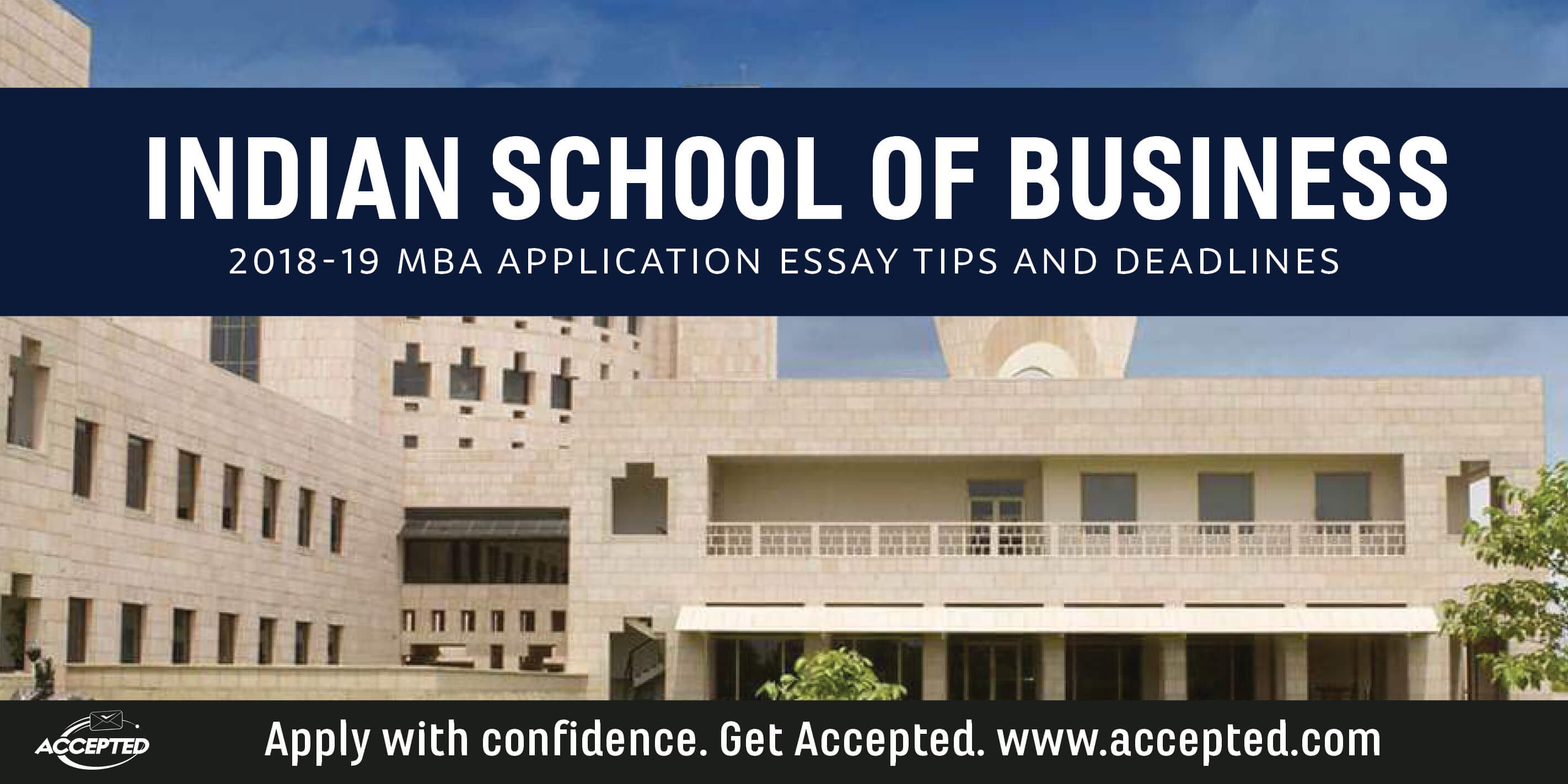
Indian School of Business campus in Hyderabad

Indian School of Business campus in Hyderabad

The Indian School of Business has become one of the strongest graduate business programs in Asia: it ranks 13th in the Financial Times’ MBA rankings – only two Asian programs surpass it according to FT, more than 98% of its graduates secure job offers within 3 months of graduating, and the salaries those graduates receive are high – 187% above their pre-ISB earnings! Competition for seats in this esteemed 1-year program is steep and the admissions process is highly competitive for native Indians.

The Admissions Office just released the application deadlines and questions for the 2013-2014 academic year. This year calls for a video submission of 90 seconds in addition to a new first question. My recommendations are in blue beneath each essay question. Unlike most other graduate business programs that allow applicants to exceed their word limits by up to 10% without penalty, the ISB application will not allow even one additional word, so applicants will need to be concise and exact!

Upload Video

Life to me is……………………. ( Please complete the following statement in your own words on Video) 90 Secs/15 MB in the format specified below.  

An increasing number of programs are requesting audio or video submissions from their applicants. These “essays” enable admissions committees to get a strong sense of the applicant beyond the written word – does he make eye contact, have good stature, appear poised, speak clearly, and with confidence? While in the past these qualities were only revealed via an in-person interview, a video submission serves as a simple screening tool for these qualities. Choose a topic and a supporting example that has special meaning to you so that you can concentrate on your delivery in this addition to the application.

Essays

1. Please make a strong case to differentiate yourselves from an exceptional set of applicants applying for PGP 2013-14. You could cite personal/ professional achievements to present your case. (300 words max)

Last year’s essay prompt was to detail your two most significant accomplishments. The difference this year is that the admissions committee is guiding you to tell about accomplishments that most other applicants cannot also describe. This is a tip that we at Accepted.com are always recommending: if someone else can tell the same story, don’t write about it. A team-leader role in a traditional IT consulting gig is probably not going to catch the admissions office’s attention, so if you do find yourself in a highly populated pool of applicants, take yourself out of that box by describing unique situations and impacts. In your essay, focus on the unique challenges you faced and how you overcame them. Do not make the mistake of listing only the awards you received without explaining what you did and how you did it. This error would make your application generic, not genuine.

2. Where do you see yourself three years after you graduate from the ISB? (300 words max)

ISB’s Admissions Director has listed “Clarity of thought in terms of career aspirations and goals” as one of the three most important qualities sought in the ISB application essays. The goals essay is your opportunity to show that you possess that clarity. If entrepreneurship is in your future, it should really appear in your past as well. If you aim for a technology or consulting role, you’ll need to demonstrate that you know what qualities you will need to succeed in these and bring some proof as to your readiness for this career. You do not need an exact map of your future, but you do need to reveal a thought process, reasoning, and evidence of your ability to reach your goals.  

3. Please provide additional information that will significantly affect the consideration of your application to the ISB. (300 words max)

The open-ended nature of this question causes infinite hand-wringing, but it should really be viewed as a gift: here is your opportunity to share whatever makes you special. This could be from your work, community service, education, or travels, so take some time to reflect and perhaps even ask your friends, relatives, or mentors their thoughts on what differentiates you. Then, go the extra step of sharing how this quality has shaped your past and future at ISB and beyond.

Key Application & Decision Dates

Round 1

Round 2

Application Deadline

September 15, 2012
23:59:59 Hrs Indian Time

November 30, 2012
23:59:59 Hrs Indian Time

Offer Decision

On or before
November 15, 2012

On or before
February 15, 2013

Acceptance Decision

15 days from
the date of offer

15 days from
the date of offer

These deadlines apply to submission of  complete application. Mere online submission of application by the deadline without supporting documents will not be considered complete. All documents have to be submitted online only. Incomplete application will not be considered.

International applicants are granted much more time to submit their applications: ISB conducts rolling admissions for them until January 15th, and liberal scholarships have been awarded to international applicants who choose to attend the program.

Resume: There is no need for submitting a separate resume.  The online application module will generate a resume in the  format that we require, with the details you have filled as part of the application.  It includes your Academic details, Employment details (along with responsibilities/achievements) and awards & activities.

If you would like help with your ISB MBA application, please consider Accepted’s MBA essay editing and MBA admissions consulting or our ISB School Packages, which include advising, editing, interview coaching, and a resume edit for the ISB MBA application. 

Jennifer Bloom

Jennifer Bloom has been helping applicants to the top MBA programs draft their resumes, application forms, letters of recommendation, and essays for 13 years. If you would you like to work with Jennifer on your application, just fill out an inquiry including any information you think will be helpful. Jennifer will contact you ASAP.

ISB Insights: Indian School of Business Admissions Q&A This Week!

Indian School of Business campus in Hyderabad

Indian School of Business campus in Hyderabad

Are you considering applying to the Indian School of Business? Do you have questions about this top Indian graduate management program’s admissions process or curriculum? If so, you won’t want to miss Accepted’s upcoming Q&A on Thursday, May 3, 2012 at 10:00 AM PT/1:00 PM ET/10:30 PM IST with Associate Director of Admissions and Financial Aid, Hima Bindu. During this interactive chat, you will learn the how, the when, and the why of applying to the Indian School of Business.

Come prepared with questions about their curriculum, student life, the experience in India for non-Indians, scholarship opportunities for international applicants, and more—Hima Bindu has the answers at her fingertips and is excited to share her extensive knowledge with you.

Register now to reserve your spot for the ISB MBA Q&A.

What time is that for me? Click on the link to find out the exact time for your location.

Accepted.comAccepted.com ~ Helping You Write Your Best

MBA Admissions News Roundup

  • The MBA TourGet to Know Top B-Schools at The MBA Tour 2012 Conferences in DC, NY & SF- Boost your knowledge of top MBA programs to better determine your fit when you participate in panels, school presentations, and an MBA fair. Benefit from meeting admissions directors, alumni, and other experts in the industry. The MBA Tour 2012 events are free. Register now at TheMBATour.com.
  • Professors are Lowering Expectations- Bloomberg BusinessWeek looks at the 2011 National Survey of Student Engagement, which shows that undergraduate business students focus less on their classes than their counterparts in other disciplines. As a result, business professors have started lowering their expectations and spending less time preparing their classes. The report feels that undergraduate business students may do less work because they have come to the major “by default.” BusinessWeek’s proof is that at top-ranked selective programs the students work longer hours because they are more dedicated.
  • UCLA Anderson Goes Paperless- UCLA Anderson School of Management has begun solely using IPADs to evaluate applications to its full-time MBA program.  They have started using technology due to the 20% increase in application volume, which the school believes is a result of the changes it has made to its core curriculum and Anderson’s focused outreach.
  • The Year for MBAs, A Retrospective- Bloomberg BusinessWeek looks at the top 10 b-school stories of 2011, providing an overview of MBA news from the past year.  With the job market improving, out-of-the-box career paths becoming more common and schools clamping down on plagiarism, it has been a good year all around. Yet, schools and students still battle financial struggles, high tuition costs and reductions in state aid.  To keep their heads above water, b-schools are offering more courses in entrepreneurship and giving the b-school experience a “head-to-toe” makeover.
  • Are Alumni Really Being Rejected? – Linda Abraham shares on Accepted’s Google+ page her take on the Wall Street Journal article about b-schools rejecting their alumni. To give you a hint, it just might have something to do with the fact that alumni used to do more of the interviewing.
  • ISB Changes Application Deadline- The Indian School of Business announced that its new application deadline is February 1st.  For those of you frantically working on your application, you just got a little more time.

Accepted.comAccepted.com ~ Helping You Write Your Best


mbaivebook-sml


MBA Admissions News Roundup

  •  What to Expect from an MBA- In an outstanding post, Robert F. Bruner, the dean of the Darden School of Business, shares what he feels is at the core of an MBA degree. By bringing forth the arguments of those who critique MBAs, Bruner clarifies what an MBA is and isn’t. He explains that Darden not only teaches theories and frameworks, but also gives its students opportunities to apply those theories. Even if graduates won’t be able to tackle everything right away, B-school will prepare them to be able to take on the most difficult tasks after a few years of experience.
  • Tepper Takes New Path- The Wall Street Journal interviews Robert Dammon, recently appointed dean of the Tepper School of Business at Carnegie Mellon University, about the school’s new curriculum that begins next fall. Tepper will no longer just be known for teaching quantitative skills, but will also focus on leadership training and writing, as well as teaching finance and operations. Dammon also tells WSJ that the MBA program plans on expanding its class size by 50% in coming years.
  • A PhD Shortage Can be a Good Thing- BizEd looks at how the changing nature of faculty at business schools has affected MBA education. While the number of academically qualified faculty has increased with Ph.D. numbers doubling in the past decade, so has the number of MBA students. As a result, there are more professionals than academics in the classroom—and this is a good thing according to the article. The faculty members that are professionals rather than academics bring “creative curricula and pedagogical innovations that are more market-focused, career-oriented, technologically supported, and globally immersive.”
  • AACSB Takes on India- The Financial Times announces that The Indian School of Business is the first business school in India to be accredited by the AACSB (the Association to Advance Collegiate Schools of Business). Equis, the European equivalent of the American AACSB, has already accredited two business schools in India.
  • MBA Gets Paid $675K…To Start!- Poets and Quants looks at the average salary  of this year’s graduating MBA class. While the highest paying graduate was from Stanford Graduate School of Business and pulled in $675,000, that individual is the exception.  Private equity firms and hedge funds usually hire the highest paid graduates, but the average starting salary is closer to $150,000 for a Stanford graduate. Not too shabby.

Accepted.comAccepted.com ~ Helping You Write Your Best


whymba


Get Your MBA Admission Smarts ON!

Are you looking for ways to boost your MBA admissions IQ? Interested in acquiring wisdom that will send you to the head of the class? Want advice that covers every aspect of the MBA admissions process that’s all wrapped up nicely in a single, coherent, and succinct BOOK?

Look no further – the MBA book of all books is here, MBA Admission for Smarties: The No-Nonsense Guide to Acceptance at Top BusinessMBA Admission for Smarties Schools, written by Accepted.com founder, Linda Abraham, and editor Judy Gruen. And now, for a very limited time only (Monday, Dec. 5 – Tuesday, Dec. 6) you can purchase this must-have book for $10 OFF the cover price by using coupon code SMARTIES at checkout. That’s almost 2/3 off the list price!

In MBA Admission for Smarties you will learn how to:

  • Determine “fit” with a program.
  • Establish your post-MBA goals and present them in a compelling goals essay.
  • Write dazzling, memorable application essays.
  • Secure winning letters of recommendation.
  • Optimize your MBA application resume.

…and much, much more!

So what are you waiting for?

Be smart. Buy MBA Admission for Smarties now!

(Non-U.S. residents should buy MBA Admission for Smarties from Amazon.com where international shipping is available. Sorry – no coupon available to ship outside the U.S.)

Accepted.comAccepted.com ~ Helping You Write Your Best

MBA Admissions News Roundup

  • Bonuses Go Down- BusinessWeek announced that bonuses on Wall Street will go down and not up in the next three years, according to an eFinancialCareers.com survey. While the 50% of the survey respondents at hedge funds and boutique banks still expect their bonus to go up from last year, analysts are predicting that employees at large investment and commercial banks are likely to see lower bonuses. The good news: 92% of respondents expect at least some kind of bonus this year.
  • ISB Doubles its Scholarships- The Indian School of Business announced that it will double the funds available for scholarships for the incoming class of 2013. Since 1 in every 7 students receives financial need or merit-based scholarships—funding 25%-50% of their education—these additional funds will make a huge difference.
  • GMAC Board Becomes More International- MBA Universe looks at the three new board members that have been appointed to the Graduate Management Admissions Council (GMAC) board of directors.  For the first time ever, one of the new members is the dean of the Indian School of Business, Ajit Rangnekar. Rangnekar’s place on the board highlights the rising prominence of Asian business schools on the international stage.

Accepted.comAccepted.com ~ Helping You Write Your Best


MBA Admissions News Roundup

  • MBA Reception Etiquette- Business schools are beginning to come to campuses, and the blog Night Owl’s Revenge looks at how you can make sure you are not “that guy/girl” that gets remembered from an information session for the wrong reasons. There is certain etiquette that should be followed at these sessions. While coming on time and dressing nicely are obvious guidelines, making sure you do not sound like a know-it-all or only speak to the highest-ranked member of the admissions committee are important tips too!
  • Choosing an MBA Over the NFL- Yahoo Sports reports that Jason Wright, who spent seven seasons in the NFL, recently chose business school over a new NFL contract. Wright rejected a contract with the Arizona Cardinals, which would have paid him $1 million a season, to pursue a full scholarship to Chicago’s Booth School of Business.
  • Johns Hopkins’ First MBA Graduates Enter the Job Market- BusinessWeek looks at how Johns Hopkins University’s Carey Business School successfully filled its corporate advisory board with representatives from prestigious companies, which then offered Carey students job and internship opportunities. 25% of the first class finished summer internships in the heath care industry. While the school was also successful in securing jobs for students in the tech industry, health-related fields seem to be Carey’s niche.
  • Asian MBA On the Rise- Forbes reports that although 57% of applicants to US MBA programs are from Asia Pacific, students may now opt to go to business school in Shanghai, Hyderabad or Singapore. While these schools need to work on brand recognition, attracting top faculty, and developing strong alumni networks with equally strong fundraising capabilities, eight Asian programs made it onto the top 100 business school rankings in the Financial Times. The high price of tuition at MBA programs in the US also makes Asia a more affordable option. To compete many western business schools are considering Asian satellite campuses.