Is There Such a Thing as Too Many Drafts? Writing a Standout Med School Personal Statement [Episode 612]
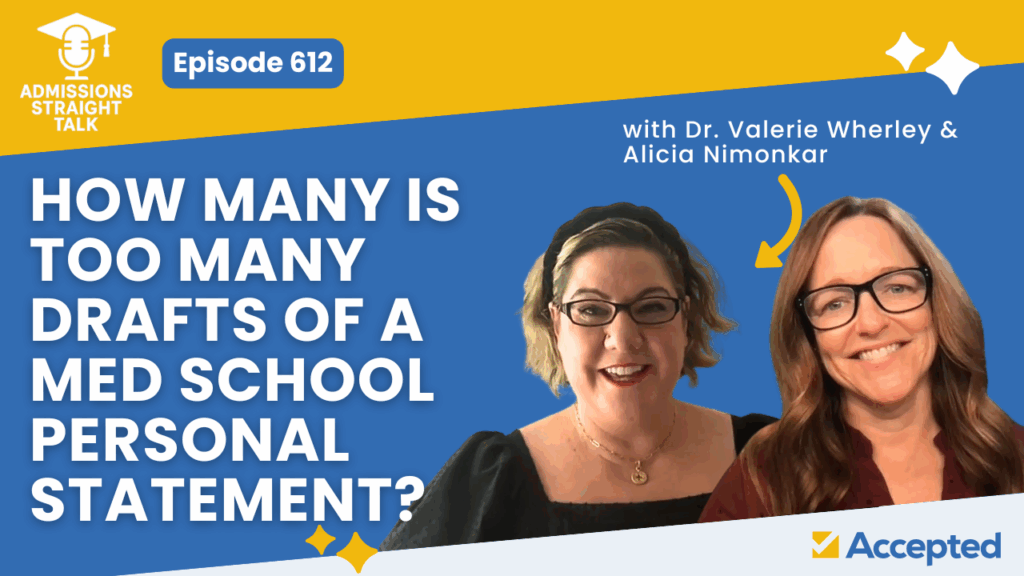
In this episode of Admissions Straight Talk, host Dr. Valerie Wherley sits down with Accepted Admissions Consultant Alicia Nimonkar, an expert writing coach with a background in composition and rhetoric, to unpack one of the most important – and often most intimidating – parts of the medical school application: the personal statement. Alicia explains how applicants can use the AAMC’s premed competencies as a framework to craft authentic, focused narratives that highlight their strengths. From creating a timeline of formative experiences to developing an outline that connects recurring themes, she shares how to identify what makes your story uniquely yours – and how to make it resonate with admissions committees.
Alicia also offers practical insight into the writing process itself: how many drafts it really takes, when to stop editing, and how to avoid the “too many cooks in the kitchen” trap of excessive feedback. She and Dr. Wherley discuss the power of resilience, effort, and voice – exploring how applicants can address challenges without sounding apologetic and how to write from a place of strength and advocacy. Whether you’re starting your first draft or polishing your final version, this episode will help you approach your personal statement with clarity, confidence, and purpose.
Table of contents

Episode Transcript
And welcome to the podcast, Alicia.
Thank you for having me. I’m so excited to talk to you and to share hopefully some helpful information.
Well, I’m looking forward to this conversation. So today we are talking about the all-important personal statement. Most medical school and other healthcare graduate programs use a holistic review process. So in your opinion, does the personal statement still carry the same amount of weight or importance that it used to?
Yes, one thing that I want to bring students attention to is the premed competencies that the AAMC uses. So these are incredibly helpful and I recommend that you keep these in mind as you’re writing your personal statement. Obviously it’s not possible to cover all of them, but you do maybe want to look at, is there one, two, or three that really stand out as a theme for you that come up again and again throughout your life and throughout your experiences. And I’m going to read those out. I hope that’s okay.
Yeah, so the competencies are cultural awareness, cultural humility, empathy and compassion, ethical responsibility to self and others, interpersonal skills, oral communication, reliability and dependability, resilience and adaptability, service orientation, teamwork and collaboration. And the last two sections are for science, human behavior, and then living systems, and then thinking and reasoning. So critical thinking, quantitative reasoning, scientific inquiry, written communication.
So you want to look at how these things have come up for you throughout your life, throughout your activities. Which of these can you feature or highlight in your personal statement?
I think that’s great advice. And I mean, really when somebody is reviewing their entire application, they should be looking at those competencies, both in their personal statement and in their work and activities to make sure we see those everywhere. But we do want to start at the personal statement to make sure, as you suggest, one, two, or three are really evident.
Yeah, I mean, I think they’ll come up again and again. It’ll be clear to people. And sometimes it’s helpful, I think, to talk it through with someone like us, right, experts in the application process, because we can help you more clearly see maybe these trends or patterns in your own life that you might not see.
Right, great advice. Well, when I first start working with clients, I’m not sure if it’s the same with you, I’m often asked, this is a hypothetical quote, “How many drafts do you think it will take until my personal statement is done?” So I’d like to hear how do you answer that question?
So typically, I do have a master’s degree in composition and rhetoric as well as English literature. So I love the writing piece. I love, love, love that. I love helping other people with their writing. I love doing my own writing. So typically with the students I work with, we do an outline first. And that outline is basically us looking at the competencies, looking at what are the patterns, the themes in your life. Sometimes I’ll have people do a timeline, and that’s fun, of important things that have come up over time. Just more data points, right, the easier it can be to see a pattern like that. And just talking it through, once we come up with an outline, typically my clients do on average two to three drafts. So, I mean, you wouldn’t build a house without a blueprint, right? Like that house wouldn’t stand, right?
So if you’ve got an outline, and I personally do not write without outlines, you know what you’re doing, you have a plan, you know what you’re building. And that can give you the way to provide strategic details, to provide anecdotes that fit within your theme or themes. It gives you that strategy so that the writing is as strong as possible. So I would say two to three drafts is typically what I see.
And I think that outline is so important, especially for the clients and applicants who start off by saying, I have so many ideas. And I think with the character count or the word count, there’s no way they’re all going to fit. And so that outline can be helpful to decide what’s going to make the cut and what probably won’t make the cut.
Well, so usually the homework before we do the outline is we come up with ten ideas. It takes ten ideas to get to one really great idea, right? So one of my favorite quotes, all-time favorite quotes, is Carol Dweck, the psychologist who wrote Mindsets. And her quote is,
The secret to life is effort.
I’ll say it again, it’s so good.
The secret to life is effort.
Right? Did you think you were gonna get the secret to life during this podcast?
I think that’s amazing. Absolutely amazing. So it takes ten ideas to come up with one best idea or one idea that’s really going to stick.
So what we do is so for homework, they’ll come up with the ten ideas and they could just jot down like a few phrases. It doesn’t have to be like a paragraph or anything and we’ll go through. So I’ll have the student describe to me each idea and there’s something like I can hear it in their voice. Like they get really excited and passionate, and I can just tell like when we get to that one idea that’s going to work, you can tell because right, have to write a whole personal statements. So you’ve got a page and a half. And if it’s an idea you’re not sure about or you’re like, this is probably what they want to hear, very often it’s not going to work as well.
Right. I agree with that so much. I’ve worked with clients before who have been writing and you can feel the struggle in the writing. You can feel them pulling, and forcing and the writing almost feels painful. And when they hit on a topic that either brings them joy or they are familiar with, the writing absolutely flows. And it’s a pleasure to read. And I think it is, I don’t know if I would say it’s a pleasure for them to write. Writing for some people, it’s very difficult, but you can tell when you have hit on that topic.
Yes. And I’ve had people cover things like one guy wrote the most amazing personal statement about peanut butter and jelly sandwiches in his intro. And you’re like, what on earth, right? But it was like, he was the kind of student who was like, I don’t have anything. I’m not interesting. Very humble and very kind. And I was like, let’s just come up with a list of ten ideas, right? And he came to one where it was like, well, I really love peanut butter and jelly sandwiches. And my mom, you know, who’s a healthcare provider, made one for me every single day in school. And I was like, gosh, that could be good. And then he’d done volunteer work about feeding the homeless in other countries. He did some research on food and health. And so it ended up being this silly idea at first. And the intro was very funny. It was a dialogue and it had you like, laughing, was very funny. In comedy, you want to be careful within the personal statement. But it was funny and it connected to this larger theme of food and health and culture and human connection. And it’s ended up, I have to say it’s probably one of my favorite personal statements that I’ve seen. But you can do anything as long as you do it well. Yeah.
Moving on to the next question, which is really answering the title of today’s podcast, is there such a thing as too many drafts of a personal statement?
Yes.
What I find is that when people say, okay, final draft, I love it, and my goal for every client is that they feel like their personal statement represents them and that they just love it, right, and that they’re excited to submit. It’s like when people get to that final draft and then they decide to show it to a bunch of other people, and they get all this different feedback, and I need to change this, change that. And if in my opinion, like, hey, that was ready for submission, it’s authentic, it’s gorgeous, it represents what you’ve done, what you’ve accomplished, right?
To go and get all that feedback and then to make changes, then you can end up with a kind of Frankenstein situation, right?
Right.
You’ve asked a lot of different people and oftentimes it’s not people with admissions experience or backgrounds. So maybe it’s a family member who loves you and is like, hey, why don’t you want to talk about that thing that happened with grandpa, right? Or an advisor who doesn’t have medical school or medical admissions experience saying, this part doesn’t flow as well or says something that kind of gives them an idea that this whole thing needs to be changed when it was strong.
Right. And I’ve also had that happen to me. And I’ve talked about the concept of too many cooks in the kitchen. Right. And so, while I can suggest that we are at final copy and the client can feel as if we are at final copy, if you show your personal statement, to ten other people, the likelihood is you will get ten new opinions. And things can get complicated and feel complicated. And you could never get at final copy if you continue to show that personal statement to more and more people. It’s okay to continue to get other people’s eyes on your personal statement, but know that you will continue to get new opinions. And so there’s got to be some point where the client and the consultant or whoever is mentoring this process has to make a critical decision and a personal decision to say, this is what I want to say. This is how I want to present myself. And this is my personal statement.
I agree.
Here’s a different question. Can someone start writing their personal statement too early as in too far in advance of their application date?
So, yeah, I do think that that is possible. If somebody starts like a year early and say they go on and get some incredible clinical experience that, you know, really inspires them, but this older draft of the personal statement, you know, doesn’t have that. So it’s helpful, I think, to wait till you’re about I would say like six months is kind of the sweet spot. I don’t know about you, but I think like eight to six months, like starting maybe that fall of the year that you’re planning on applying. That way you give yourself enough time to really your best work, to not be stressed out or doing things at the last minute.
Because it is… this is the first chance you have in the personal statement to introduce yourself in your own words to the selection committee. That’s huge, right? So that’s such an important piece of the application. Because if you, I mean, you know, if you’ve come across a personal statement where there’s a red flag or something alarming or something where it’s unfocused or you don’t understand what they’re trying to say, it’s like pass on to the next one.
So, yeah, that statement does hold quite a bit of power. So, I would say starting eight months, six months before, and then that way you’ve probably had those experiences already that you want to talk about.
Yes, yes, I couldn’t agree more. I’m going to ask you a question that I hadn’t pre-planned, but I’m sure you’re going to navigate it beautifully. Should applicants talk about deficits or missteps they’ve had in their journey in their personal statement? Maybe academic deficits or… something like a nonlinear path.
I would cover only the things that you have addressed because you don’t want to come across as a pawn, right? Or a victim or somebody who doesn’t, you know, who is disempowered, right? Because you’re introducing yourself for the first time in your own words.
Yes.
So you’re telling your story, you want to come across, right, as the most powerful piece on the board. So, yeah, so you just want to make sure, if you can repeat the question again.
So the question was, do you recommend that applicants talk about academic deficits, particular challenges, whether it was health challenges, financial challenges, or moments of a nonlinear path in their personal statement?
Yeah, so it is about portraying yourself as someone who overcomes things, someone who is persistent, someone who meets challenges as opportunities. And there’s an incredible book I can recommend: The Obstacle Is the Way. Have you heard of this one? I believe it’s Robert Holiday is the author. I know his last name is Holiday. But The Obstacle Is the Way.
I haven’t.
So portraying yourself in a position of power as having overcome those obstacles as maybe you got a low grade or you had some low grades one term or semester or quarter, but you turn things around. You came back and were victorious. So you want to demonstrate the challenges you’ve overcome because that itself is a strength. But if you’re just using this space in the essay to complain, or to show yourself as a victim, or in my experience in the 18 years I’ve been doing this, I’ve never come across a statement where, for example, someone’s talked about being bullied and I haven’t seen anybody get accepted with like that kind of any kind of a victim mentality, any kind of a will this thing happen to me? And while I’m certain that that thing did happen, right? I’m sure like that thing happened.
But if, for example, you go on to overcome the thing that was the challenge and that you helped other people who had to overcome that challenge, that’s what I see the most successful. I think the most powerful example I could come up with is a student who had been a victim of sexual assault, and she later went on to become a victim advocate. And so she would go to hospitals and support women who were going through like right, the exam that’s required after an assault. And, you know, she became a leader in several organizations to support education, to bring awareness, to prevent sexual violence. And she just did amazing things. And so she did not portray herself as a victim. You know, she portrayed herself as someone powerful with the ability to help others overcome challenges and to educate and prevent those things from happening in the future. So she came at it from a place of power and advocacy and finding ways to support others and to empower others and improve conditions. It was amazing to work with her.
That is a very, very good story. And I do hope everyone who is listening, who is asking the question, can I talk about X, can take the example that you just gave and apply it to their own situation, whether it’s a personal health challenge, the loss of a family member and think, okay, if I talk about it, can I come at it from a place of resilience, power, and advocacy? Because those are really some key pieces. So thank you for sharing that particular story. And the final question today is, when does someone know their personal statement is done?
I think you get that feeling when you read it. So one thing I always do with clients is I offer it. And almost everybody actually does it. Because I don’t know, I just love this process of working with students and helping them see what is amazing about themselves. Because it’s hard to see it in yourself, right? I just love reading through the final draft. So usually the outline is fun. It’s just a bunch of questions, talking, us doing strategy, thinking through things, figuring out how to represent things in the most positive way. And then, right, there’s the drafts, which are so, if you use the outline, the hard work’s already been done of strategy, of strategic detail, of what you’re going to cover and how you’re gonna cover it. So the drafts are just fun through email. And then the last part of the personal statement is I recommend that we read through it together. And you just get that feeling, you know, like when you’re reading through it of like, wow, and you can hear their excitement. And most people are surprised that they didn’t think it would be as good as it is. And it’s like, know when they’re excited to submit it, that is such a good feeling.
Yes, yes, that is part of the satisfaction of the work that we do, which is helping clients and students tell their story and tell it in a way that they didn’t think was possible and that is authentic and creative and that they’re really proud of.
Well, I think this has been very helpful. I learned a few things too, which will help me, and I’m sure that will help the listeners. So thank you so much for your time today.
Related Resources
- AAMC The Premed Competencies for Entering Medical Students
- Mindsets: A View From Two Eras
- The Obstacle Is the Way
- Alicia Nimonkar bio and contact information
Related Admissions Straight Talk Episodes
- The Fastest Way to Medical School Is Slowly: Avoiding Early Premed Mistakes [Episode 608]
- How to Overcome the Biggest Weaknesses in Med School Applications [Episode 605]
- Rejection and Reapplication: How to Respond [Episode 523]
Subscribe Links
- Apple Podcasts
- Spotify
- Wherever you get your favorite podcasts