Inside the University of Miami’s Three-Year M.D. Accelerated Pathway [Episode 615]
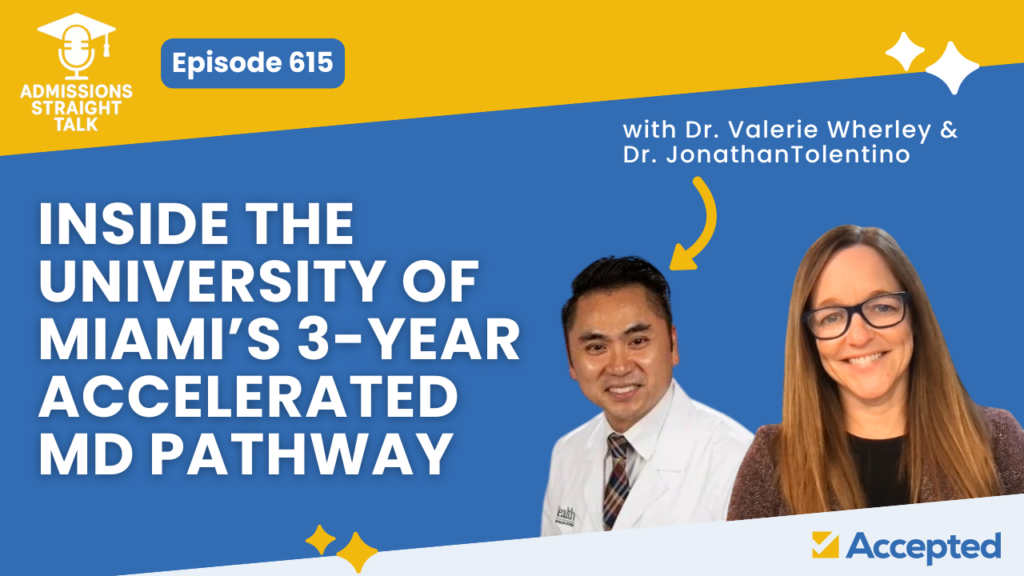
In this episode of Admissions Straight Talk, host Dr. Valerie Wherley speaks with Dr. Jonathan Tolentino about the University of Miami Miller School of Medicine’s innovative three-year Accelerated Pathway to Residency Program. Designed for students with a clear specialty focus, this program allows participants to earn their MD in 36 months while maintaining rigorous academic and clinical training.
Dr. Tolentino explains why three-year MD programs are gaining traction nationally and how Miami’s model supports early professional identity formation, cost savings, and efficient preparation for residency. He walks listeners through the program’s curriculum structure, including the summer clinical immersion experience, longitudinal clinical exposure, and mentored scholarly project.
The conversation also explores residency matching opportunities across 18 specialties, how and when students opt into the accelerated pathway, and what happens if a student needs to decelerate into the traditional four-year track. Dr. Tolentino closes by outlining what makes a competitive applicant, emphasizing clarity of specialty interest, thematic preparation, and strong academic readiness.
This episode is especially valuable for applicants considering accelerated medical education and for those who already have a well-defined career vision in medicine.
Table of Contents

Episode Transcript
And thank you for joining us and welcome to the podcast.
Thank you, it’s a pleasure to be here today.
Great, so we are here today to talk about the three-year MD accelerated pathway at the Miller School of Medicine at the University of Miami. And this program began in 2019. The first question I think our listeners would be interested in hearing is why? Why was this program created and what need is it fulfilling?
So that’s a great question. So three-year programs nationally has really taken a lot of, has become really increasingly more popular amongst medical schools and really kind of helping as it’s educators rethink how do we better train medical students going into different specialties. And I think this was a really great opportunity for us as an institution to really think about, can we train medical students within three years? Can we help with cost savings? Because we know that medical schools are expensive and they’re getting more expensive and the financial savings is huge. But the other part of it is it really helps medical schools, residency programs at medical schools kind of realign how we train medical students, how we train and develop medical students into surgeons or psychiatrists or general internists.
Especially for those students who have a very clear path and already decided. And I think that’s one of the really great opportunities as medical educators, as a medical school, it’s a really great opportunity to kind of really hone in on some of those skill sets. And other medical schools, when we first started, when we started looking at some of the data and some of the other medical programs, I’ll start looking at data, had very similar outcomes between three-year programs and four-year programs.
And so one of the things that I think was really exciting for us here at the University of Miami was that opportunity to really provide an educational experience that allowed for earlier, more meaningful, earlier professional identity formation, especially for those students who knew what they wanted to go into, had a very clear path, kind of walked into medical school saying, “I want to become a neurologist. I’ve been doing this work as a basic scientist or I’ve been doing this work in undergrad and I have a very clear path.” We wanted to take advantage of that excitement that we see in our medical students. And I think that’s been one of the really great fulfilling things as this program has really grown over the past several years.
It’s interesting that you say that. I’ll add my own two cents. I did some research on three-year programs and posted a blog for the work that we do here at Accepted. And the data does show that graduates of three-year programs and four-year programs are equally satisfied and feel equally trained, regardless of whether they’ve done a three-year program or a four-year program. And the three-year graduates feel less encumbered by their financial debt, of course, than most four-year graduates. So it sounds like the goal of your program is achieving what it had intended to do. So excellent.
So onto my next question. I know that some parents and students get concerned when they hear about the abbreviated curriculum that maybe some items have been quote unquote left out. So this is a 36-month program and the curriculum is clearly described on your website for any listeners who are interested, but I was wondering if you could detail how students still acquire the necessary credits to graduate in a shorter period of time.
So that’s a great question and we get that question all the time. Will I come out equally as trained? Some of the things we really felt was important when we designed the curriculum, we put everything together, is that the preclinical core curriculum as well as the clinical curriculum that we typically think of your typical third-year medical school, that stays the same between the three-year program and the four-year program.
So you’re still getting all the biochemistry, you’re still getting all the pathophysiology, we set everything up into systems. That curriculum is the same between the next-gen four-year curriculum as well as the three-year accelerator program. Same thing also with the core clerkships. You’re still getting neurology, you’re still getting internal medicine, pediatrics, so you’ll be well trained as the rest of your classmates and all that still stays the same.
What’s different about the three-year accelerator program is our eight-week summer immersion program that we do between the first year and the second year. It does give you eight credits over that summer. And during that time, that’s when we spend a lot more time building some of the professional identity formations as we discussed before. You spend a little bit more time really building your own skillsets and the specialty that you’re interested in. And on top of that, we spend a little more time on bedside skills where we talk a little bit more and we train a little bit more on how to take a history, how to build some of the clinical decision making that we talk about in the clinical clerks, but we try to do that a little bit earlier as a way to not only accelerate that skill set, but really making the clinical immersion experience much more meaningful.
So the slight difference that happens in our phase three or the last few months of the curriculum is that you still have your sub internship. And so you still spend four weeks working as an acting intern or a sub intern. You have about ten credit hours of elective time where you can spend time really exploring your specialty. But the only difference is that we’ve shortened some of the elective experiences that you won’t do, but you still do the transition to residency rotation to really prepare yourself for that. Our philosophy really is that you know what you’re planning on going into. You got a lot of those experiences earlier in your curriculum. You have some time to do electives in that phase three of your third year of your medical school. But because you know where you’re going, you kind of know the skill sets, and we’ve been building you with those skill sets over the past three years, you’re already prepared to go on into your residency. And so it’s not that we’ve taken anything out, but what we’ve really done is we’ve really built those skillsets over three years so that you’re prepared for your residency after those three years.
That sounds great. And I’m sure that students and parents and people who are supporting applicants are happy to hear that nothing is quote unquote cut out. It has just been creatively integrated into a 36 month.
Yes, 100%. And I think what’s really wonderful about that integration is that we’re really looking at building skill sets early, integrating that, and almost mirroring some of the preclinical courses that the medical students are doing. But then on top of that, really assuring that the medical students are getting the core basic science, the core basic clinical skill sets as a four-year student would in a short amount of time, but doing it in a more efficient and we hope more effective way.
Well, one might think that in a shortened curriculum like this or an abbreviated curriculum, you certainly couldn’t have time for anything additional such as research. But your accelerated program includes three unique curricular components. The first is a longitudinal clinical experience, which you’ve alluded to. The second is actually a mentored scholarly project. And the third is clinical immersion and professional courses, which we’ve also talked about.
I was hoping you could talk briefly about each item, maybe a little bit more about that mentored scholarly project. It seems really kind of almost wild to think that in addition to this condensed course curriculum, students also have time for a mentored scholarly project.
And again, we take this from the standpoint of this is all longitudinal, right? This is a continuum between what you do in medical school and what you do in residency. So let’s start off with the longitudinal clinical experience. So we start that in your first year of medical school, where it’s not just learning the, not only are you learning the basics of how to take a history and how to talk with patients and what have you.
But starting in the spring semester of your first year, you’ll spend a half day working directly with the specialty that you’re interested in. So you’ll spend a half day in surgery clinic, you’ll spend a half day in internal medicine clinic or on the wards, and you really are getting the early clinical experience so that not only do you understand and you’re interested in some of the academic work, but you really are seeing through the lens of an internist or a psychiatrist, what does it mean to interact with patients. And I think that’s such an important part of really building your identity as a particular specialist. And that continues through the clinical immersion course. And that clinical immersion course that happens for those eight weeks is almost like a mini clerkship, but it’s really wonderful because you spend time in various different parts of the specialty, whether you’re in procedural suites, whether you’re in the clinic or whether you’re working in the hospital, really understanding from an intense standpoint how a physician in that particular specialty works, how they learn, building some of those skill sets, and really taking the context of what you did during your preclinical courses into what you do at the bedside. On top of that, like I mentioned before, we spent a little more time building some of those clinical skill sets.
Then you also have time to do research and kind of go into the one point you brought up is how do students in an accelerated program do research? And I think one of the things that we really looked at is one, in our clinical immersion course, setting aside time for a mentor scholarly project where students are paired with a research mentor to put together a project, really think about a project.
But the project here is not a project you finish in medical school. It’s a longitudinal project you start building the basic structures that you could potentially continue on into residency. Because again, it’s a continuum and medical education really is a continuum. There aren’t just blocks of medical school and then suddenly you do residency. It’s all one large continuum that we really take advantage of as part of the scholarly, when it comes to the scholarly project.
And so we work with medical students to think about what is a big question that you want to answer or what is a big thing you really are interested in that you could see yourself doing into residency. Now we know that projects change and ideas change, but it really is to get those research uses flowing early with the intent of thinking how could these projects continue on into residency?
Or maybe how does the research question change as you get further into the project? So there’s no expectation that you’re going to finish something in those three years because we recognize how busy that time is. But we really want to get the project started now so that this could potentially go on into your intern year, second year of residency, third year residency, and so forth.
So it sounds like a really good time to start some foundational pieces of a scholarly project to continue on to your residency time.
Yes, exactly.
Well, speaking of residency, that brings me to my next question. So residency matching opportunities. In researching other three-year accelerated MD programs, I saw opportunities for students to match, but mostly in primary care specialties, which is fine if that’s what a student is interested in. But your program offers 18 different specialty areas to match in. Can you talk a little bit more about that?
Yeah, so we’re one of the more unique accelerated programs. We recognize that as accelerated programs come, while many are designed for the primary care specialty, sort of generalist specialties, the University of Miami has a long history of producing wonderful medical students and having wonderful medical students here.
And one of the things we really wanted to kind of look at is how can we bring in other specialties, especially some of even some of the more competitive specialties to be part of this three-year pathway. And this has been something that we have worked on and have designed with the specialties to really craft a really unique experience and then an accelerated pathway. Really taking advantage of that clinical immersion professional course during the summer months to kind of build not only that professional identity formation, but a lot of those skill sets that are needed, especially for some of the more demanding surgical sub-specialties. So, you know, we’ve been blessed to have so many wonderful partners in some of our specialties from radiation oncology to neurology to neurosurgery to neurology and OB-GYN.
And it’s been a wonderful experience for many of our medical students and many of our program directors. And so we work very closely with each of the program directors and specialties to craft a really not only exciting, but really meaningful accelerated pathway. Now, because some of the programs are smaller, the number of students they can take are going to be smaller because of that.
But like I said, we’ve been very blessed to have such wonderful partners within our specialties.
I would think that that would make your program very appealing to potential applicants to know that the specialty areas are much more broad than your traditional primary care areas.
Yes, for sure. And this is something that we’ve been very proud of now for the past several years as we brought on new specialties over the past, especially over the past two to three years.
Next up, I have a logistical question. When do students opt into the accelerated pathway and do they need to have an idea of their specialty area of interest at the time they opt in?
So for our program, we have two ways in which students can opt in. We do have a pre-matriculation path where students who have an interest in Accelerated Pathway complete a secondary application noting their interest in the Accelerated Pathway. And that’s something that is included as part of the application process to the University of Miami.
In order to be considered for Accelerated Pathway, you first have to be accepted into the medical school first. We don’t determine acceptances as part of the Accelerated Pathway. For those students who have not quite decided they want to be in Accelerated Pathway, they matriculate into the School of Medicine. We do have a second option of a post-matriculation opt-in that occurs in the spring of the MS1 year.
And at that time, for any available positions in the accelerated pathway, we do offer that in the post-matriculation path. Again, we’ll be limited based upon availability of slots. The vast majority of our students go through the pre-matriculation pathway. Now, the question about having an idea of specialty area, that is one thing that we do require. You do have to have an idea of, or defined interest area in order to participate in the accelerated pathway. And that could be through a number of different things from either your prior experience in research, work experiences, any clinical experiences that you did as part of your work coming into medical school, any leadership that you’ve done, or any advanced degrees that may be related to the specialty of interest. A lot of it is because our curriculum is really designed from day one to build on your professional identity as well as your professional skill sets. And so we want students who come in to have a very clear idea that they want to become a surgeon because from day one of the accelerated pathway, we start building your skill sets as a surgeon or we build your skill sets as an internist or a pediatrician. So that’s part of the reason that for our accelerated pathway, students have to have a very clear idea of the specialty that they want to go into.
Okay, all right, that makes a lot of sense. I’ll have another question about that at the end. So here’s a different logistical question. If there’s a scenario where a student is not succeeding academically in the accelerated pathway, maybe not hitting some of their milestones, or if they decide on a different specialty area, what options are available to them?
Yeah, so initially whenever students have concerns about their performance or what have you, we try to work with them early in order to see what resources that are available through our education office to kind of help support our students. And I think that’s one of the first things that we do as a pathway. We want to make sure that students who are interested and are in the accelerated pathway are as successful as possible in Accelerated Pathway. And I think that’s really our first step.
Now in situations in which students are not succeeding academically, the first thing that we think of as a program and the School of Medicine thinks of is we have to support the student. And one of the things that we really think about is if a student is struggling or does need a repeat, we don’t want to put them in a situation where they feel the pressure of having to stay in the accelerated program and they continue to struggle. And so in those cases, we often will suggest or place them back into the four-year program because we want to make sure that the students are successful, that they are learning the medicine, and that they’re not put under the undue stress of having to try to still stay in the success of your path and continue to struggle academically. And I think that’s something that we have lots of conversations with the medical students.
We want to make sure that we’re supporting the students. We have recognized that it can be a difficult decision, but at the same time, we’re not thinking we have to keep pushing you in a way that stresses you, but we have to push you. We want to make sure that we’re doing things that make you successful for your career 20, 30 years down the road.
Now, in cases where students decide they want to go to a different specialty area, often we do have medical students decelerate back in a four-year program because we want to make sure that you get all the experiences that you need and we recognize that up to that point everything has been based upon one specialty area. And so we want you, as a medical student to, if you want to go from surgery to psychiatry, for example, and everything has been all about surgery and you’re like, “Gosh, I love psychiatry,” well, you need more time in psychiatry. You want to spend more time doing some of the scholarly work in psychiatry. You want to spend more time doing the electives in psychiatry and kind of build that skill set. And so that’s part of the reason that we have medical students decelerate in order to allow them that time to really build that skill set. Because up to that point, we’ve done everything we can to build them into another specialty.
So it’s only fair to the student in their future career that we provide them those experiences.
That makes a lot of sense. And I would think that having that other plan available at your home institution is very comforting. It’s not as if you’re saying to students, “If this three-year pathway doesn’t work, you have to look to go to a different institution.” I mean, transferring as a medical student is close to impossible. It’s a very, very difficult process. Having that four-year pathway, having a deceleration plan is very comforting to be able to stay at your home institution.
Exactly. And for us here at the Miller School of Medicine, we’re all about making sure that students are able to fulfill the career path they want to and making sure that we have, that we’ve thought about everything and especially in these situations where students recognize that their path may be different than initially intended. And so we want to make sure that we have delineated but that we do everything and have all the resources available to support them along that path.
Here’s the final question, and I ask a very similar final question to all program directors and admissions professionals. And that final question is, what would a competitive application look like for your particular program?
And I’ll go back to two questions prior. I’m assuming that a competitive application would be somewhat thematic in that you’re looking for a theme of somebody who has explored the world of pediatrics or the world of geriatrics. But I was wondering if you could talk a little bit more about that.
Yeah, so exactly. I think that’s a great way of putting it. Because program directors and Accelerated Pathway are really looking at trying to build specialists from day one, having an application that really demonstrates, one, a clear understanding of the reasons why an Accelerated Pathway makes sense for them, for their career path, but then really an understanding of the specialty that they want to go into, that they understand what pediatrics is, for example, as you mentioned, why it makes sense for their career path, what they have done in the past that really has demonstrated that they understand what pediatrics entails.
The one thing we recognize is participating in Accelerated Pathway and discovering the specialty is not what you expected, it’s very disheartening, but also we want to make sure that we’re using your time wisely in medical school and that if you need that time to explore, the four-year program is designed for that. And that’s what we want to make sure that you’re in the right path. Because if you come into an accelerated pathway, but you’re still split between surgery and neurosurgery and neurology and internal medicine, but everything that we’ve done for you is focused on that area, it can be very disconcerting, but more importantly, it’s not serving you well.
So when we think about competitive applications, it really comes down to have you had that chance to explore, do you have those experiences, and do you have a clear understanding of why neurology or why neurosurgery makes sense for you and that you understand a little bit about the lifestyle, but you understand the specialty in itself and like what it entails. I use neurology and neurosurgery as an example because a neurosurgeon doesn’t do exactly what a neurologist does and vice versa. So understanding that delineation, I think, is such an important part when you walk into an accelerated program. And that’s on top of having a strong academic record. And we do have a minimum MCAT score of 510 in order to qualify for the accelerated pathway.
That’s very good insight. And in the work that I do in guiding applicants, I typically guide applicants to not pigeonhole themselves into a specialty area at the point of application. I think that most four-year programs would prefer applicants to be open to that exploration phase during clinical rotations, particularly year three so they take full advantage of every single clinical opportunity.
But for those who really have this, again, this very thematic application between volunteerism, patient contact, leadership, non-paid medical clinical work, a three-year accelerated program really could be a good fit.
Yes, totally. And I think this is kind of one of the great things about an accelerated program like this, where when you walk in, you really feel, “I’m going to be a cardiologist from day one.” An accelerated program is a really great way of being able to use your medical experiences in a very unique way, but I think in a way that really helps your career path moving forward.
Great. Well, I think I learned something and I’d like to thank you so much for your time today.
No, this has been an absolute pleasure. Thank you so much for having me on your show today.
Related Resources
- Dr. Jonathan Tolentino bio
- Contacts for more information on the University of Miami’s Accelerated Pathway:
- Dr. Tolentino: jxt1084@med.miami.edu
- Erica Simms: esimms@med.miami.edu
- University of Miami Miller School of Medicine Three-Year M.D. Accelerated Pathway
- Medical School Secondary Essay Tips
- A Strategic Guide for Applying to Medical School
Related Admissions Straight Talk Episodes
- Is There Such a Thing as Too Many Drafts? Writing a Standout Med School Personal Statement [Episode 612]
- How to Apply Successfully to Med School from Postbac Programs [Episode 526]
Subscribe Links
- Apple Podcasts
- Spotify
- Wherever you get your favorite podcasts