The Bryn Mawr Postbac Premed Program [Episode 614]
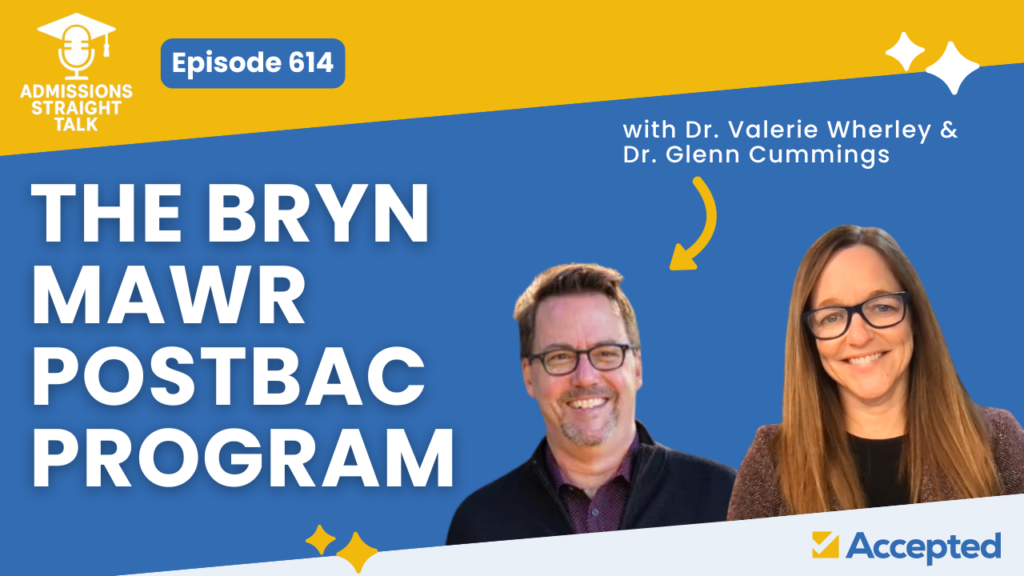
In this episode of Admissions Straight Talk, Dr. Valerie Wherley welcomes Dr. Glenn Cummings, associate dean and director of health professions advising at Bryn Mawr, for an in-depth look at one of the nation’s oldest and most respected career-changer post-bac pathways. Dr. Cummings explains the distinctive mission and history of the Postbaccalaureate Premedical Program – founded in 1972 at Bryn Mawr College – and clarifies what truly defines a “career changer” in the post-bac world. He walks listeners through the program’s rigorous 12-month curriculum – including the accelerated summer chemistry sequence and the full-time fall and spring science load – while also outlining how Bryn Mawr supports students through intensive academic advising, structured MCAT preparation, and opportunities for clinical volunteering, research, and service.
Dr. Cummings also highlights the program’s unique advantages, such as its extensive network of medical school linkage partnerships, its individualized W.I.S.E. advising model, and its robust alumni mentoring system. In addition, he discusses what the admissions committee looks for in competitive applicants: strong academic performance, demonstrated motivation for medicine, a history of service, and the maturity to thrive in a tight-knit, collaborative cohort.
Whether you’re a true career changer, a recent graduate ready to pivot toward medicine, or simply exploring structured post-bac options, this episode offers valuable insights into how Bryn Mawr prepares students not only for the application process but also for success in medical school and beyond.
Table of Contents

Episode Transcript
And welcome to the podcast. So to start today, I was wondering if you could provide the listeners with a brief background of the history of the Bryn Mawr Postbac Premedical Program.
Sure. Thank you. Well, our program is one of the first in the country, if not the first. We’re not exactly sure what the first program was, but we were founded in 1972. So we’re in our 54th year right now, a 54th cohort of premedical students. We were founded at an historically women’s college, Bryn Mawr College, as an opportunity for women to go back after their college experience was over and get the courses that they needed to go to medical school. We’ve been coed for many, many years since then, but that was the origin of the program. And we have students in our program from so many areas of the world and so many places. We have teachers, former teachers, lawyers, military people, finance, artists, professional athletes. You know, we really draw students from all sorts of disciplines and they’ve all, the one thing they have in common is they want to go to medical school.
So you have a longstanding history, which is a great place to start. So my next question is, your post-bac program is specifically designed for career changers. And I was wondering if you could start by first defining that term. What is a career changer? And then the second part of my question is, can you talk about how your post-bac program differs from a program that is targeted towards someone known as an academic enhancer?
I appreciate that question very much. As I’m sure you know, there’s a good bit of confusion out there about what a post-bachelor program is, let alone a career-changer post-bachelor program. We always chuckle every application cycle because at least one phone call we get asked about the post-bachelorette program. They don’t even get the name of the program quite right. But we are a program for individuals who have not taken the core required courses for medical school. And they’re starting from scratch. We are sometimes also referred to as a start-from-scratch program, as well as a career-changer program. They may have taken one or two of the courses in the past, but outside of five years ago. So if they’ve taken the courses within the last five years, especially if they’ve taken more than just one or two, if they’ve taken almost all of them, then they’re not really eligible for our program because we are trying to teach them the science classes from square one. That is the difference really right there between us and an academic enhancement program, just in the sense that we’re not designed to help people who’ve already had the courses enhance their academic credentials. We’re designed for people that are very high achieving and quite successful in college to then go take the science courses and transition.
Honestly, we have two types of career-changer students and one of them is a true career changer. And that’s someone who’s actually been, like I mentioned before, in another area for a number of years and is now transitioning toward medicine for a variety of different reasons. We do have another younger group of students that are much closer to having graduated from college. And you can’t really call them a career changer necessarily, but they have come to medicine toward the end of college and then realized that there just wasn’t enough time left to get the requirements done. And also they’ve been in an institution that had so many opportunities and so many wonderful things that they could do that they just decided not to do the premed curriculum in addition to double majoring and studying abroad and being an athlete or whatever it is. So we kind of have two types, but we call them all career changers.
So that second point’s really interesting because I was director of a post-bac program at a university in Connecticut. And so my traditional view of a career changer is the accountant who has decided they want to become a physician, right? Or the social worker who has decided they want to become a physician. But this view of maybe a psychology major, undergraduate student who is graduating but simply didn’t have time because they did all these wonderful extracurriculars can be viewed as a career changer. That’s really what you’re saying.
They’re certainly eligible for our program and we have a group of them in our program every year. I stopped a little bit short of calling them career changers because like I said, they haven’t really had a career, but they’re starting from scratch and our program is certainly open to them as well.
That’s a great, that’s a very helpful definition. I want to take a little bit of a deep dive into your curriculum. So in prepping for this, I read that your curriculum is a 12-month program with noted full-time study. So what does a sample semester class schedule look like?
We run from late May every year to the following May. So there are really three sections of the curriculum. The first section is over the summer. So it’s not a semester, but it’s a year’s worth of general chemistry that they take in ten weeks over the summer. That’s all the students are doing. It’s accelerated, but it’s very focused. And they get general chemistry out of the way. And then in the fall and spring of the traditional academic year, they take the rest of the courses. So they’re taking organic chemistry, biology and introductory physics in the fall. And then in the spring, they’re taking the second half of physics, the second half of biology. And then our organic chemistry class in the spring also has biochemistry in it. So it’s an integrated course that includes both of those classes. So in 12 months, in a full-time program, they can complete all the requirements that most medical and dental schools actually require.
We do have a few pre-dental students in the program sometimes as well.
So I do have to ask, is it fair to say that the students in your program typically are not working in addition to taking these classes? It sounds like a very heavy workload.
It is, and we actually don’t advise them to try to work because the focus is on academic success and it’s a full-time job, just taking these classes. That doesn’t mean that some of them don’t manage to do a limited part-time job. Also, our program has some part-time jobs built into it that you can apply to do. We pay some of the students to do different things, like to be a peer tutor, for example, in the program. So there’s a way to generate a little bit of income when you’re in the program, but we are, just out of necessity working very much outside of the courses just is impossible.
Now I know in working with students, when students are trying to find a post-bac program, they are considering the unique features of a post-bac program. And sometimes it’s a very difficult decision to decide which program is the right program for them. So having said that, can you talk about some unique features of the Bryn Mawr Postbac Premed Program?
Sure. Gosh, several things come to mind. I’ll try to be as brief as I can. But there are several features that maybe are shared by other post-bac programs, but I think they’re unique at Bryn Mawr because we devote a lot of time and attention and resources to them. The first one would be our linkages. We have 13 medical school partners and one dental school partner that we currently have a linkage agreement with, which means that if you’re in the program, halfway through the program, if you’re eligible, and if you’re a pretty strong prospect, you can apply to one of our partners, just one. And if you’re accepted, then you can potentially, well, not potentially, I mean, you can start school immediately following the completion of our program.
If you don’t do a linkage, then you would be taking a glide year after you finish the program because you’d be in the application process. So I think it’s unique because we have so many of them. I mean, 13 medical schools is a lot. And I think that distinguishes us a little bit. Another thing that comes to mind would be what we call W.I.S.E. advising. And W.I.S.E. is an acronym, the Bryn Mawr mythical figure that the students all referred to as Athena, the goddess of wisdom. So several years ago, I came up with a kind of a philosophy of advising that tapped into that idea of wisdom. So W.I.S.E. stands for welcoming, individualized, strategic, and experienced. And, you know, I certainly talk to candidates when they apply to the program a lot more about our philosophy of advising.
But I do think that two full-time advisors devoted to a cohort of around 70 students is a great opportunity for people in our program to really get guidance that’s based on experience and really have some individualized help in succeeding academically, but then also obviously getting coached through the process of leaving us and going on to the next step. So that’s a big one. Oldbac mentoring.
Oldbacs, we refer to them at Bryn Mawr. We refer to the alums of our program as Oldbacs. It’s just kind of a fun term. I don’t know that it’s really caught on anywhere else, but in 54 years of alumni of this program, we have a lot of old backs out there in the community. And there are a lot of opportunities for us to have them speak to students and have them mentor and guide students. Oldbac mentoring specifically is a one-year-out relationship. The people who finished the program just last year can volunteer to be a mentor to current students in the program. And so current students in the program can have their own personal Oldbac mentor who were in their shoes just a few months ago. And that’s been a great source of moral support and kind of guidance for our current students. So I mean, those are three things that I can think of that I feel like are a little bit unique to Bryn Mawr.
I have a couple of follow-up questions. For the linkage programs, for the students that qualify, does that mean the medical students do not have to take the MCAT and the dental students do not have to take the DAT?
It depends on the school. So about half of them, I’d have to do the math, but about half of them do require you to take the MCAT. And your acceptance mid-year is conditional upon you then taking the MCAT in the spring and scoring the score that they want to see. The other half, there’s some of our older partners and they have had such a long history of Bryn Mawr post-bacs going to their medical schools and doing well. And they know how rigorous the one year can be. So they’re very kind and they wave the MCAT. So it really just depends on the program.
And with your advising structure, which is fantastic because I hear of other students sort of being handed a document and saying, take these classes. And it’s sort of self-advising. Does that advising structure offer guidance through the AMCAS application and the AADSAS application?
Yes. Yes, very much so. We’re not done working with our post-bacs until they’re done with us. And that’s what I always say. So, you know, I’m advising them sometimes even before they arrive in May and then certainly throughout the year that they’re with us. But then when they’re in the application process through the centralized application services, writing a committee letter, how to gather your letters together, help with the personal statement, preparing for interviews.
All the things that you do when you’re actually in the process, we also help them with. And at some point when they’re in medical school and I’m in touch with them and they email me very kindly and they say, “We have advisors here in medical school that can help us. Thank you very much, Glenn, but you don’t need to keep helping me. I moved on.”
Your job here is done. Well, that’s great. Let’s talk about getting your students really ready and competitive for medical school or dental school. Do you offer opportunities for students to enhance their premed or pre-health portfolio with such things as clinical experience, research, and volunteer work?
I’ll add a little addendum. It sounds like the students are really busy with their classwork. So if you do, when does all of this happen?
Sure. It is built into the program in a way that it is possible to do volunteer work and/or research while you’re in the program. It doesn’t leave much time for working like we were talking about before, but there is time to do those types of things because they’re just essential to you being a strong applicant. And I think especially with the clinical volunteering, they’re essential to reminding you why you’re doing what you’re doing. Why am I in these classes, right? I want to be a physician. So getting out there in a clinical setting is really important. I mentioned two of us that are devoted to advising full time. My colleague has some specialty areas that she focuses on. And one of them is helping the students secure volunteer work in the greater Philadelphia medical community during the year that they’re with us.
And most post-bacs will volunteer three to ten hours a week, usually three to five hours a week, but some of our sites require a few more hours. And she’s the liaison between the program and all those different sites around Philly. And some of them do involve research as well. It’s hard sometimes, honestly, to have in-depth, meaningful research when you’re in school full time and also doing your volunteering. At the Children’s Hospital of Philadelphia, at our Cancer Center here in Philly, there are some opportunities where you can have a clinical experience that also involves research. You know, it’s clinical research. So it’s both. And that’s been nice. And then the service component, I mean, I’m always telling students, you know, “Do your clinical volunteering. But if you care about a population of individuals or a cause, some social cause or something, don’t stop doing it while you’re in our program.” But it’s the lowest priority, honestly, because they do have so many other commitments.
It really sounds like a holistic opportunity for post-bac students. I mean, there are some post-bac students that really, really focus on academics, but to be able to offer volunteer opportunities, if students meet with their advisor and their advisor says, this is what your portfolio looks like, and it looks like there’s a weak area or an opportunity of growth during this post-bac program and volunteering could really kind of fulfill that weaker area in your portfolio and your post-bac program can offer that, it really sounds like it’s beneficial for the student and their upcoming application.
Right. I mean, as I said before, individualization is one of our mottos around here. And we have some nurses that come into the program. Do they need more clinical experience when they’ve been a nurse for three years? You know, not always. So I might direct them more to getting research or I might direct them more to doing other types of service. But then we have some individuals who are coming out of a completely unrelated, not even adjacent field. I mean, a complete career changer. And then we would direct them certainly into more traditional clinical volunteering at a hospital or a community health clinic or something like that. So it really just depends on the individual.
With the exception of the students who might be linking to programs that don’t require an MCAT, for the rest of your cohort – and I believe you said that cohort number is about 70, you can correct me if I’m wrong – for the rest of your cohort, do you offer MCAT test prep?
We do. It’s certainly a very important part of the application process to medical school. We hire an individual called the MCAT Fellow every year, and they start working for us in August. So over the summer, the students are focused on taking chemistry, and that’s all they’re doing. But starting toward the end of the summer and the early fall, the MCAT Fellow starts holding sessions.
We call them review sessions, but they’re not just review of the material. They’re also strategy sessions. They talk about test taking strategy. So it starts not weekly, but they’re kind of monthly in the fall. So not very overwhelming. And the students are told, given a lot of advice on how to fold MCAT review into their weekly routine. And then over winter break, and as we move into January, the MCAT fellow moves to more weekly sessions as we move toward actually taking the MCAT. And then the students are encouraged to fold their MCAT prep into a daily routine, not just a weekly routine. And they’re reviewing some flashcards or they’re doing something every day to prepare them. So it’s about, what would that be? Six- to nine-month period leading up to the MCAT, depending on when they take the MCAT, where they’re working with the MCAT Fellow here in the program.
Wow, excellent structure. Very, very good. Yeah. Well, my final question that I ask all program directors on this podcast is, what are you looking for in a competitive applicant that might be interested in your program?
Again, thank you for that question because it’s very helpful. Anyone listening to this, if they’re interested in the program, I’m sure that’s on their mind, right? Because we’re not an academic enhancement program, honestly, we are looking very closely at the applicant’s academic background and we want to see a sign of strength. Going back to high school, we actually ask for high school transcripts as well because sometimes the quantitative work that they’ve done or their performance in STEM courses, you have to go back that far to see it. I mean, if they were a humanities or social science major in college, they may not have any of that work to review. So we look at that and we do look for students, no matter what they studied, that are intellectually curious and have really succeeded in the courses that they’ve taken in college. The average GPA of the students in our program is usually between a 3.6 and 3.7 undergrad GPA that they bring in with them. So just to give you a sense of things.
But beyond the metrics, mean, probably the most important thing is a demonstrated motivation for doing this, you know, especially when they’re a true career changer that’s been in another field for a number of years. What’s driving them to make such a transformational change in their life? And what’s it based on? So some sort of demonstrated experience, maybe some actual clinical experience or just something, it could even be a personal experience. It doesn’t always have to be a professional experience, but something in their life that convinces us that they’re going to thrive in the program and then that they’ve really given us a lot of thought that they’re making a decision.
There’s a certain amount of bravery we look for. I like the word “bravery.” I don’t know, you could call it grit or courage or whatever you want to call it, but we are a fairly intensive one-year program and we want people to be all in and they have to be in looking for some demonstration of that in their past, know, some depth of commitment to something that they really enjoy doing kind of would indicate to us that that they’re going to be okay. Love of service. I mean, medicine is a service profession, right? And so no matter what their job was that paid the bills after college, you know, we always like to see maybe on Saturday mornings, were they doing something in the community and helping other individuals other than themselves? That’s always helpful.
And then guess the last thing that comes to mind, and that’s a lot, I know. You don’t have to have all these things. It’s just, these are the things we look for. But we are a tight cohort. I mean, people come to our program, I think, because they want to be going through the premed experience with people that will become friends and sometimes lifelong friends. And we have some, you know, co-curricular activities, committees, social programming, things like that, that are also part of the program. And so we’d love to see in an applicant someone who cares about community, you know, community building, being part of a social setting. And they’re not just a lone wolf that’s going to go into the library and disappear for a year. You know, they’re going to be engaged with their fellow students. So we see…
We’re very fortunate to have a cohort every year that really kind of is, you know, epitomizes all those things. It keeps my job very interesting and a lot of fun to work with these types of students. I learned something from the post-bacs every day. I always say this, but especially when they come from other fields and other professions, I come home at the end of the day knowing what some term finally means when I never knew what it meant or some area of our society that I just hadn’t explored before. So it’s really fun to work with those students.
I totally agree. I have a follow-up question. Do you require letters of recommendation? If so, how many, and how much weight do those letters of recommendation carry?
We require two letters of recommendation, no more than three. So they can have a third if they want to. The only stipulation we put on it is that one of them needs to be what we call an academic letter. It needs to be from someone who is familiar with their academic path. So typically someone who taught them, but it might also be an advisor. That’s the only additional little requirement. And they play a significant role. The strong ones play a very strong role. You know, if you see, if you write, read a letter and you can just tell that not only one letter, but maybe two different individuals just really loved working with this person that that really affects what the committee thinks as well. I think, you know, honestly, some letters are just kind of neutral. And we very rarely see a negative letter that hurts anyone’s application, very rarely. So it’s either neutral or significant in terms of how we weight them.
Well, I’m not sure about you or maybe if any particular stories come to mind, but as we kind of close this podcast, I know in working with post-bac students, particularly career changers, I remember I worked with somebody who curated art in an art museum and decided that they wanted to go into medicine who just had such a unique story. I always remember that particular person. I worked with a history major who decided to come back and take all of the premed courses, who was very successful in his application cycle. So some of those very unique stories I remember because their personal statement flowed very nicely and they also had this very strong desire to pursue medicine. And in my opinion, their applications must have stood out to an admissions committee because they weren’t the bio major, chemistry major. So do you have any similar stories?
We do. Many, many, many stories. It’s, I mean, we’ve had, I mentioned some of the different types of backgrounds that some of the students have had already, but we’ve had artists, we’ve had, this year we have a professional musician who worked for a symphony for many years. He’s one of our older students. And then we have people that are in more traditional, the business industry or education or law or something like that. And the one thing that they all bring, in addition to some maturity. I mean, maturity is big, right? They just have a sense of themselves, I think, that’s a little different than the younger students. But they bring transferable skills from what they’ve done. And one of the things I do in my advising is really make sure that they understand what those skills are and not try to slam the door behind them and say, “Well, I did that now. Medical schools aren’t going to care about what I did before.” Because you’re right. I mean, I’ve seen too that medical schools do very much care and it does help them stand out in an application.
And even if it’s pretty far afield from medicine, there’s something that they were doing that they’re bringing with them that’s going to make them a better physician. You know, it can be, you know, working on a team. It can be dealing with difficult personalities in your job. It can be dealing with the stress of deadlines. It can be all sorts of things that they think, “Well, you know, I was at a bank. I mean, what does that have to do with medicine?”
But when you really dig deeper, there are a lot of skills that our doctors should have as well, that they have some training in that area. And it’s really helpful to, it’s really fun for me to help them articulate that when they apply to medical school.
Absolutely. Thank you so much for sharing all of the details about the Bryn Mawr Postbac Program. This has been fantastic.
Wonderful, was a pleasure. Thank you.
Glenn Cummings, PhD, has been the associate dean and director of health professions advising at the Postbac Premedical Program at Bryn Mawr College for over 11 years. He arrived at Bryn Mawr in 2014 with previous pre-health advising roles at three other institutions. Born and raised in the Midwest, Dr. Cummings went to Maine for college, graduating from Colby College with a degree in English and creative writing. He went on to receive his MA and PhD in English from the University of Virginia, turning to a career in academic advising in 2000. He has directed the pre-health advising offices at the University of Virginia, Princeton University, and Franklin & Marshall College. Dr. Cummings has worked on numerous projects for the National and Northeast Associations of Advisors for the Health Professions over the years, including a committee letter task force, an initiative developing resources for LGBTQ+ pre-health students, and the Postbac Committee.
Related Resources
- Dr. Glenn Cummings contact information
- Bryn Mawr Postbac Program email: postbac@brynmawr.edu
- The Basics of Postbac Programs: What You Need to Know
Related Admissions Straight Talk Episodes
- How to Apply Successfully to Med School from Postbac Programs [Episode 526]
- Is a Postbac Program Right for You? [Episode 403]
- The Fastest Way to Medical School Is Slowly: Avoiding Early Premed Mistakes [Episode 608]
Subscribe Links
- Apple Podcasts
- Spotify
- Wherever you get your favorite podcasts